Working Caregivers: Claim 12 Weeks Paid Family Leave Benefits
Advertisements
Paid family leave for caregivers in the United States depends heavily on where a worker lives, who employs them and which federal, state or employer-sponsored protections apply.
Federal FMLA can provide eligible workers with up to 12 weeks of job-protected leave for qualifying family and medical reasons, but that leave is generally unpaid.
Actual wage replacement may instead come from a state paid family and medical leave program, employer benefits, accrued paid leave or another qualifying source.
There Is No Universal Federal Paid Family Leave Program
The United States does not currently have a federal law guaranteeing paid family and medical leave to private-sector workers nationwide.
Instead, federal law establishes unpaid job-protected leave through the Family and Medical Leave Act for eligible workers employed by covered employers.
Paid benefits are available in certain states and through some employers, meaning two caregivers in different locations can have very different rights.
FMLA and Paid Family Leave Are Not the Same Thing
FMLA protects eligible workers who need time away for qualifying family or medical reasons, but the law itself does not generally require employers to pay wages.
Paid family leave programs provide wage replacement during qualifying leave and are usually established through state law, employer policies or negotiated benefits.
In some situations, FMLA and a paid leave benefit can run at the same time, giving the worker both wage replacement and federal job protection.
FMLA Can Provide Up to 12 Weeks of Protected Leave
Eligible employees can generally use up to 12 workweeks of FMLA leave during the applicable 12-month period for qualifying family and medical reasons.
During FMLA leave, covered employers must maintain group health benefits under the same conditions that would have applied if the employee continued working.
At the end of qualifying leave, workers generally have the right to return to the same job or a virtually identical position.
Military Caregiver Leave Can Reach 26 Weeks
The FMLA also contains a separate military caregiver entitlement that can provide substantially more than the standard 12-week leave period.
An eligible employee may receive up to 26 workweeks during a single 12-month period to care for a covered servicemember with a serious injury or illness.
This entitlement should not be confused with ordinary family-care leave because it has its own qualifying relationships and military-related requirements.
Who Qualifies for Federal FMLA Leave?
An employee generally must have worked for the employer for at least 12 months before FMLA leave begins.
The worker must also have completed at least 1,250 hours of service during the 12 months immediately preceding the beginning of leave.
For most private-sector workers, the employee must work at a location where the employer has at least 50 employees within 75 miles.
Covered Employers Also Have Requirements
The FMLA generally covers private employers that employed at least 50 workers for 20 or more workweeks in the current or previous calendar year.
Public agencies and local educational agencies can also be covered even though the eligibility requirements for individual employees must still be satisfied.
Workers who do not qualify for federal FMLA may nevertheless have rights under state family-leave laws, disability protections or employer policies.
Which Family Care Situations Qualify Under FMLA?
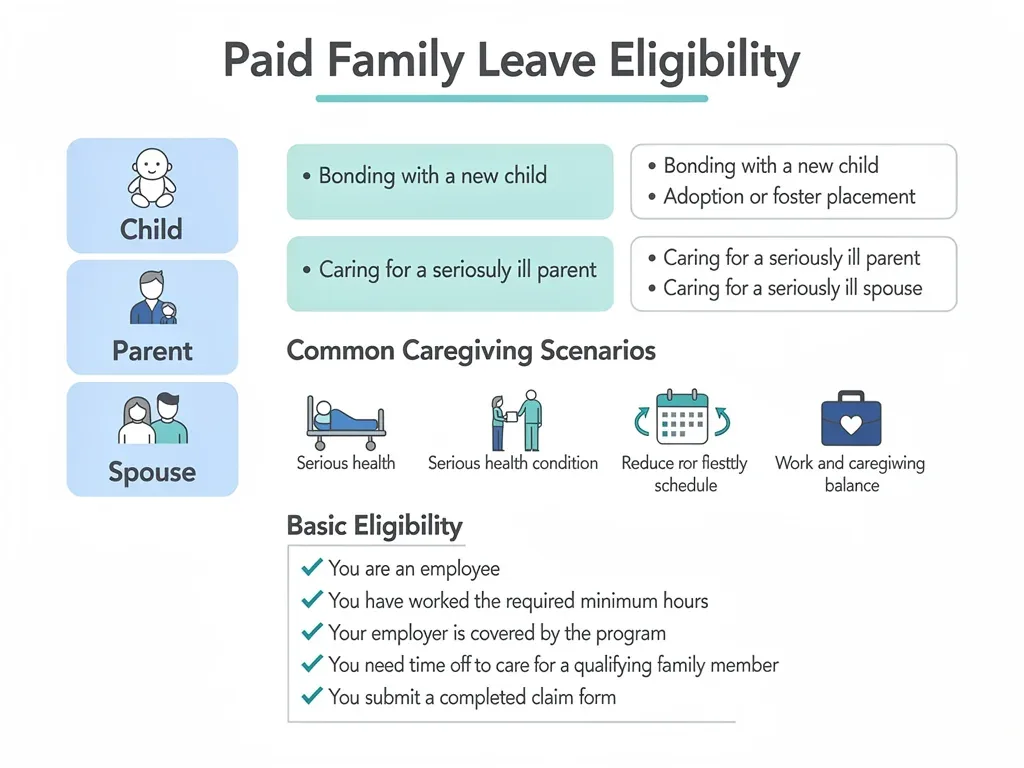
Eligible workers can use FMLA leave to care for a spouse, child or parent with a qualifying serious health condition.
The federal law also covers bonding following the birth of a child or placement of a child through adoption or foster care.
Certain qualifying exigencies associated with a spouse, child or parent's covered military duty can also support FMLA leave.
Federal FMLA Uses a Defined Family Structure
The standard FMLA caregiving provisions do not automatically cover every relative or person whom an employee considers family.
For ordinary serious-health-condition caregiving, the federal statute focuses primarily on a spouse, son, daughter or parent.
Some state paid family leave programs use broader family definitions, which is one reason workers should review both federal and state rules.
What Counts as a Serious Health Condition?
FMLA does not apply every time a relative has a minor illness because the law uses specific standards for a serious health condition.
Qualifying situations can involve inpatient care or continuing treatment by a healthcare provider when the regulatory requirements are satisfied.
Chronic conditions, periods of incapacity and certain treatments may qualify depending on the medical circumstances and required documentation.
Medical Certification May Be Required
An employer can generally require appropriate medical certification when FMLA leave is requested to care for a family member with a serious health condition.
The certification can address the condition, expected duration and why the employee's caregiving involvement is medically necessary.
Workers should respond to documentation requests promptly because incomplete or delayed certification can interfere with approval of protected leave.
Where Paid Family Leave Benefits Actually Come From
Workers who receive wages while taking family leave often receive those payments from a state program, employer policy or accrued paid-leave balance.
The US Department of Labor reports that multiple states and the District of Columbia have enacted paid family and medical leave programs for eligible workers.
These systems can provide partial wage replacement during qualifying caregiving, bonding or medical leave while operating separately from federal FMLA requirements.
State Programs Do Not All Work the Same Way
Eligibility, covered relationships, benefit duration, wage-replacement percentages and maximum weekly payments vary from one state program to another.
Funding mechanisms also differ, with programs using employee payroll contributions, employer contributions or combinations established under state law.
A worker should therefore use the rules of the state where employment is covered rather than assuming another state's paid-leave benefits apply.
Some States Protect a Broader Definition of Family
State paid-leave programs can recognize relationships beyond the narrower categories included in ordinary federal FMLA caregiving provisions.
Depending on the state, covered relationships may include grandparents, grandchildren, siblings, domestic partners or other qualifying individuals.
This broader coverage can make state benefits particularly valuable for workers whose caregiving responsibilities do not fit the federal FMLA definition.
Always Check the Program's Current Definition
Family definitions can change as states amend paid-leave statutes or expand administrative rules governing benefits.
Workers should verify current eligibility through the agency responsible for the program instead of relying on older summaries or another state's rules.
The existing paid family leave policy guide can provide additional context when comparing broader policy developments.
Paid Leave and FMLA Can Run at the Same Time
Receiving payments from a state program does not necessarily create an additional 12 weeks of protected leave after federal FMLA is exhausted.
When the same absence qualifies under both programs, paid family leave and FMLA can run concurrently according to applicable rules.
This means the worker may receive income replacement while the same weeks count toward the federal FMLA entitlement.
Coordination Prevents Double Counting Expectations
A worker should ask whether state leave, employer leave and federal FMLA run concurrently before planning several consecutive periods away from work.
Assuming each benefit creates a separate block of leave can lead to an inaccurate estimate of how long employment protection will continue.
Human resources or the relevant state agency can explain how overlapping programs interact in a particular employment situation.
Job Protection Depends on the Law That Applies
Paid benefits and job protection are not automatically identical because one program may replace wages while another provides reinstatement rights.
Federal FMLA offers job protection to eligible employees of covered employers regardless of whether the leave itself is paid.
A state paid-leave program may provide its own employment protections, but the details and eligibility conditions vary among jurisdictions.
Paid Benefits Do Not Automatically Guarantee Reinstatement
A worker should not assume that receiving a state payment automatically means the employer must hold the exact same position throughout the absence.
Job protection may instead come from FMLA, a separate state leave statute, a collective bargaining agreement or an employer policy.
Understanding which law protects the job is just as important as determining which program replaces part of the worker's wages.
Employers Cannot Retaliate Against Protected FMLA Use
Federal law prohibits employers from interfering with, restraining or denying workers' lawful exercise of FMLA rights.
An employer also cannot lawfully retaliate against an employee because the worker requested or used qualifying FMLA leave.
Workers who believe their federal rights were violated can contact the Department of Labor's Wage and Hour Division or explore other available remedies.
Document Important Communications
Employees should keep copies of leave requests, notices, certifications and relevant communications with supervisors or human resources.
Written records can help clarify what leave was requested, when notice was given and how the employer responded.
This documentation can become particularly useful when several leave programs overlap or when a worker believes protected rights were denied.
Workers Usually Need to Give Advance Notice When Possible
When the need for FMLA leave is foreseeable, federal rules generally require employees to provide at least 30 days of advance notice when practicable.
If 30 days of notice is impossible because circumstances change unexpectedly, the employee generally must provide notice as soon as practicable.
The worker does not always need to use the term “FMLA,” but must provide enough information for the employer to understand that protected leave may apply.
Emergencies Are Treated Differently
Caregiving needs can arise suddenly when a relative becomes seriously ill, is hospitalized or experiences another unexpected medical event.
Federal rules recognize that workers cannot always provide a month's warning before an emergency requiring immediate family care.
Employees should still notify the employer promptly and follow normal call-in procedures when those requirements are practical under the circumstances.
How to Apply for State Paid Family Leave
The application process depends on the state and may involve an insurance program, labor agency or another designated administrator.
Workers commonly need employment information, earnings records and documentation supporting the caregiving or bonding reason for leave.
Some programs also require employer information or medical documentation before wage-replacement benefits can be approved.
Start With the Official State Agency
Workers should identify the government agency that administers paid family and medical leave where their employment is covered.
Official program websites normally provide eligibility rules, current benefit formulas, application instructions and required forms.
Using the official source reduces the risk of following outdated application steps or benefit amounts published by third-party websites.
How Paid Family Leave Benefits Are Calculated
State paid family leave programs generally replace a portion of wages rather than continuing a worker's full normal paycheck.
Many programs calculate benefits using prior earnings or an average weekly wage and apply a maximum weekly benefit amount.
The percentage and cap differ significantly among states, so there is no single national formula for paid family leave for caregivers.
Lower Earners May Receive a Higher Replacement Percentage
Some state systems use progressive formulas designed to replace a larger percentage of wages for lower-paid workers.
Higher earners may reach the program's weekly maximum even when their normal salary is substantially above that amount.
Caregivers should calculate expected payments before leave begins so household budgets reflect the actual benefit rather than ordinary take-home pay.
Intermittent Leave Can Be Important for Caregivers
Family caregiving does not always require several uninterrupted weeks away from work because medical needs can occur periodically.
Federal FMLA can allow intermittent leave or a reduced schedule when medically necessary for qualifying serious health conditions.
This structure can help a caregiver attend appointments, provide treatment support or respond to recurring periods when a family member needs assistance.
Intermittent Paid Benefits Depend on State Rules
State paid-leave programs can establish their own minimum increments and requirements for receiving benefits during intermittent absences.
Workers should therefore determine whether the state program pays for partial weeks, individual days or smaller qualifying periods.
Coordination with the employer remains important because payroll, scheduling and state-benefit reporting may all need to reflect the intermittent arrangement.
New-Child Leave Can Include Birth, Adoption or Foster Placement
Federal FMLA allows eligible employees to take qualifying leave after the birth of a child or placement through adoption or foster care.
Bonding leave generally must be used within the first 12 months following the qualifying birth or placement.
State paid-family-leave systems can provide wage replacement for similar bonding periods when the worker satisfies the applicable state eligibility rules.
Parental Leave Is Only One Part of Family Leave
Paid family leave is often associated with new parents, but caregiving for seriously ill relatives represents another major use of these programs.
An aging parent, spouse undergoing treatment or child with a serious health condition can create substantial demands on a working caregiver.
Understanding the broader scope prevents workers from incorrectly assuming paid family leave is available only after childbirth.
Military Families Have Additional FMLA Protections
FMLA provides qualifying-exigency leave when an eligible employee's spouse, child or parent has qualifying covered military duty.
The law also provides the separate military caregiver entitlement of up to 26 weeks for care of certain covered servicemembers.
These protections involve different eligibility and documentation requirements from ordinary caregiving for a civilian family member.
Military Leave Is Not Automatically Paid
Like ordinary FMLA, federal military family leave is generally an unpaid entitlement unless another source of paid leave applies.
An employer policy, accrued paid leave or applicable state program may provide income during some qualifying absences.
Workers should distinguish the source of job protection from the source of wage replacement when evaluating military-family leave.
Employer Paid Leave Can Supplement Public Programs
Some companies offer paid parental, family-care or general paid-time-off benefits that exceed what federal law requires.
Employer benefits can sometimes coordinate with state payments so the worker receives additional wage replacement during qualifying leave.
The exact interaction depends on company policy, state law and whether the employer uses accrued leave concurrently with FMLA.
Review the Employee Handbook and Plan Documents
Company leave policies can specify eligibility, pay rates, documentation requirements and whether paid time must be used before or during another leave program.
Workers should also check collective bargaining agreements or employment contracts when those documents provide additional leave rights.
Understanding internal benefits can reveal paid options that are not obvious from federal or state statutory programs alone.

Health Insurance Can Continue During FMLA
A covered employer must maintain an eligible employee's group health coverage during FMLA leave under the same conditions that applied while the employee worked.
The employee may still be responsible for the normal employee share of premiums during the absence.
Workers should confirm how payments will be collected when payroll deductions cannot operate normally because wages have stopped or decreased.
Other Benefits May Follow Different Rules
FMLA specifically protects continued group health-plan coverage, but other employment benefits may operate according to employer policies and applicable laws.
Workers should ask how vacation accrual, retirement contributions, bonuses and other benefits are treated during the leave period.
Clarifying these questions before leave begins can prevent surprises when an employee returns to work.
Paid Leave Does Not Always Mean Full Pay
The phrase “paid family leave” can create the impression that an employee receives their entire normal salary throughout the leave period.
Most public programs instead provide partial wage replacement according to statutory formulas and weekly maximums.
Employer-sponsored programs can be more generous, but the exact benefit should always be confirmed rather than assumed.
Calculate the Household Budget Before Leave
Caregivers should estimate the benefit amount, taxes when applicable and any continued insurance premiums before deciding how much leave they can afford.
Households may also need to account for increased transportation, medical or caregiving expenses during the same period.
Financial planning can make the available leave more useful even when the program replaces only part of regular earnings.
State Programs Are Expanding Across the Country
The Department of Labor reports that 13 states and the District of Columbia have enacted paid family and medical leave programs.
Additional states have implemented or developed programs at different times, meaning the practical landscape has changed considerably over the past decade.
Workers should monitor current state guidance because benefit availability can depend on when a newly enacted program actually begins paying claims.
Some States Use Voluntary Insurance Models
Not every jurisdiction uses the same mandatory social-insurance structure for family and medical leave benefits.
Some states allow voluntary private insurance arrangements for employers or workers instead of operating the same type of statewide mandatory benefit program.
This diversity makes state-by-state research essential when determining whether a particular worker can receive paid caregiving benefits.
Caregivers Should Separate Four Different Questions
When evaluating leave, first determine whether the absence qualifies for federal or state job protection.
Second, determine whether any program replaces wages, and third, identify how long both the protected leave and paid benefits can last.
Finally, verify which family relationships and medical circumstances qualify because these definitions can differ between overlapping programs.
One Program May Not Answer Every Question
FMLA may protect a worker's job while a state benefit replaces income, and an employer program may supplement the remaining unpaid portion.
Another employee may qualify for state payments but not meet federal FMLA tenure or employer-size requirements.
Viewing these programs as separate but potentially overlapping layers produces a more accurate understanding of available caregiver support.
Steps to Take Before Requesting Family Leave
Start by reviewing employer policies and determining whether the company and employee meet federal FMLA requirements.
Then check whether the state provides paid family and medical leave and identify the agency responsible for applications.
Finally, collect medical or family documentation early enough to meet employer and state deadlines without delaying the start of benefits.
Create a Leave Timeline
Record the expected start date, anticipated duration, employer-notification deadline and any state benefit application dates.
Also note whether leave will be continuous, intermittent or divided among family members who are helping provide care.
A written timeline makes it easier to coordinate healthcare appointments, employer requirements and household finances during a stressful period.
Paid Family Leave for Caregivers at a Glance
Paid family leave for caregivers in 2026 remains a combination of federal job protection, state wage-replacement programs and employer benefits.
The federal FMLA can provide up to 12 weeks of protected leave for many qualifying situations, but federal law generally does not require those weeks to be paid.
The table below separates these concepts so caregivers can identify which protection they actually need to investigate.
Paid Leave and Protected Leave Must Be Evaluated Separately
A paid benefit answers how the worker receives income, while job-protected leave answers whether qualifying employment must generally remain available.
Some workers receive both protections simultaneously, while others qualify for only one because state and federal eligibility rules differ.
Understanding that distinction eliminates one of the most common sources of confusion surrounding US family-leave benefits.
Key Area | 2026 Position |
|---|---|
Federal FMLA | Up to 12 weeks of generally unpaid, job-protected leave for qualifying reasons. |
Federal Private-Sector Paid Leave | No universal federal law guarantees paid family and medical leave to private-sector workers. |
FMLA Eligibility | Generally 12 months employed, 1,250 hours worked and applicable employer/location requirements. |
State Paid Leave | Available in multiple states, with different eligibility, duration and wage-replacement formulas. |
Military Caregiver FMLA | Can provide up to 26 workweeks in a single 12-month period for qualifying covered servicemember care. |
Employer Benefits | May provide additional paid leave or supplement state and federal protections. |
Frequently Asked Questions About Paid Family Leave
Does federal law guarantee 12 weeks of paid family leave in 2026?
No. Federal FMLA generally provides up to 12 weeks of unpaid, job-protected leave for eligible employees, while paid leave may come from state or employer programs.
Who qualifies for federal FMLA?
Most eligible employees need 12 months with the employer, at least 1,250 hours of service and a qualifying worksite covered by FMLA rules.
Can I use FMLA to care for a seriously ill parent?
Yes. Eligible employees can generally use FMLA leave to care for a parent with a qualifying serious health condition.
Can I take FMLA to care for a grandparent?
Not automatically under ordinary federal FMLA caregiving rules, although special circumstances or broader state leave laws may provide protection.
Can family leave be intermittent?
Yes, FMLA can allow intermittent or reduced-schedule leave when medically necessary for a qualifying serious health condition.
Does my employer have to keep my health insurance during FMLA?
Yes. Covered employers must generally maintain group health benefits under the same conditions that applied before the qualifying leave.
Can state paid family leave and FMLA run together?
Yes. When the same absence qualifies under both programs, the paid benefit and FMLA job-protected leave can operate concurrently.
How much does paid family leave pay?
There is no national amount. State programs use different wage-replacement percentages, earnings formulas and maximum weekly benefits.
Do I need to give 30 days' notice?
When FMLA leave is foreseeable, workers generally should provide at least 30 days' notice when practical; emergencies can follow different timing rules.
Can employers punish workers for taking FMLA?
No. Federal law prohibits interference with FMLA rights and retaliation against workers for properly exercising those rights.
Can military caregivers receive more than 12 weeks?
Yes. Eligible employees can receive up to 26 workweeks during a single 12-month period to care for certain covered servicemembers.
Conclusion
Paid family leave for caregivers is not a single nationwide 12-week paid benefit, but a combination of federal, state and employer protections.
Federal FMLA provides eligible workers with important job protection, while state paid-leave programs can provide wage replacement under their own eligibility and benefit rules.
Caregivers should identify which laws cover their employment, confirm application deadlines and coordinate paid benefits with FMLA before planning an extended absence.