Navigating SSI Asset Caps: Retain Eligibility Above $2,000
Advertisements
Understanding SSI asset caps in 2026 helps beneficiaries protect their financial resources, identify eligible asset exclusions, explore ABLE accounts and special needs trusts, and maintain compliance with Supplemental Security Income requirements.
Understanding SSI asset caps is essential for individuals receiving Supplemental Security Income who want to manage their financial resources without unnecessarily jeopardizing their eligibility.
Although federal resource limits remain at $2,000 for individuals and $3,000 for couples, certain possessions and qualifying financial arrangements are excluded from these calculations.
This guide explains the applicable exemptions, legal financial management strategies, updated ABLE account requirements, reporting responsibilities, and common mistakes beneficiaries should avoid in 2026.
Understanding SSI asset rules and exemptions
Supplemental Security Income provides financial assistance to eligible individuals who are aged, blind, or disabled and meet specific income, resource, and other eligibility requirements.
The Social Security Administration evaluates countable resources, including available cash, bank balances, investments, and certain property that individuals can use for their support.
Understanding SSI asset caps helps applicants distinguish between countable financial resources and possessions that can be retained without automatically affecting their eligibility.
Key exempt assets for SSI eligibility
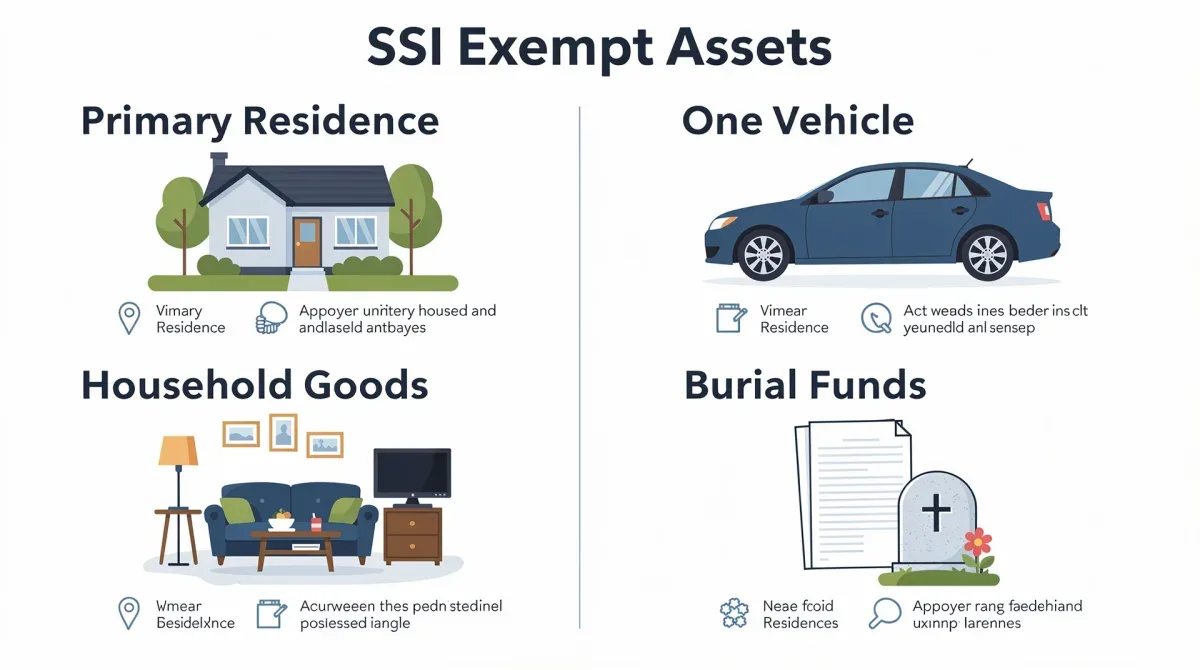
The home where an individual lives, ordinary household belongings, personal effects, and one vehicle used for transportation are generally excluded from SSI resource calculations.
Qualifying burial spaces and certain burial funds may also receive exemptions, subject to applicable conditions and restrictions established by the Social Security Administration.
The official SSA guidance on SSI resources provides additional information about excluded assets and their relationship with federal eligibility requirements.
Understanding countable financial resources
Cash, checking accounts, savings accounts, stocks, bonds, and certain additional properties may count toward the applicable SSI resource limit when they are available to beneficiaries.
Jointly owned accounts and resources belonging to certain family members may also affect eligibility, depending on ownership arrangements and applicable resource-deeming requirements.
Successfully managing SSI asset caps requires considering all applicable resources rather than focusing exclusively on the balance of a single personal bank account.
How SSI asset caps affect monthly eligibility
The federal SSI program generally evaluates countable resources according to their value at the beginning of each calendar month when determining resource-based eligibility.
Receiving additional money during a month may affect income calculations immediately, while funds retained into subsequent months may become countable resources unless excluded.
This distinction is important because income and resources are evaluated under different rules when determining eligibility for SSI and other public benefits.
Can you own more than $2,000 in total assets?
Yes. An individual may possess assets worth substantially more than $2,000 when some of those assets qualify for exclusions under applicable SSI regulations.
For example, someone may own an excluded primary residence, an eligible transportation vehicle, household belongings, and additional countable savings below the applicable resource threshold.
The SSI asset caps apply to countable resources rather than the combined market value of every possession owned by an eligible individual.
Example of exempt and countable resources
Consider an individual who owns a primary residence worth $150,000, an eligible transportation vehicle worth $10,000, and a savings account containing $1,800.
Assuming the residence and vehicle qualify for exclusions and no other countable resources exist, the individual's countable assets would generally total $1,800.
This hypothetical example demonstrates how beneficiaries may own substantial excluded property while remaining below the individual SSI resource limit.
Strategic asset management: Trusts and special accounts
Certain legally established trusts and specialized savings accounts can help eligible individuals with disabilities manage financial resources while maintaining access to essential public assistance.
However, these arrangements must satisfy specific requirements, and establishing an ordinary trust or transferring money between accounts does not automatically create an exemption.
Before using financial structures to manage SSI asset caps, beneficiaries should obtain appropriate professional guidance and understand their continuing reporting responsibilities.
Special needs trusts explained
A qualifying special needs trust may hold assets for a person with disabilities without those assets necessarily being treated as available countable resources.
The applicable requirements depend on the trust's funding source, the beneficiary's circumstances, distribution restrictions, and the legal provisions governing its establishment.
Even when a trust itself is excluded, certain distributions may affect SSI payments, making careful administration and professional oversight particularly important.
First-party and third-party special needs trusts
First-party special needs trusts generally contain assets belonging to the beneficiary, while third-party trusts are funded using assets belonging to other individuals.
A qualifying first-party special needs trust generally must be established for a disabled individual under age 65 and satisfy applicable Medicaid repayment requirements.
Third-party trusts follow different considerations, making specialized legal assistance valuable when evaluating their relationship with SSI asset caps and other public assistance programs.
Understanding pooled special needs trusts
Pooled trusts are generally established and maintained by nonprofit organizations that manage funds for multiple beneficiaries through separately maintained beneficiary accounts.
These arrangements can provide access to specialized trust administration when establishing an individually managed special needs trust would be financially or operationally impractical.
Age-related transfer rules, distribution restrictions, administrative expenses, and repayment provisions should be reviewed before transferring personal assets into a pooled trust.
ABLE accounts: A savings solution for eligible individuals
Achieving a Better Life Experience accounts provide a tax-advantaged savings arrangement for eligible individuals whose disabilities or blindness satisfy applicable federal qualification requirements.
These accounts allow beneficiaries to accumulate funds for qualified disability expenses while receiving favorable resource treatment under certain public assistance program regulations.
ABLE accounts represent an important option for managing SSI asset caps, particularly when individuals want to establish dedicated savings for future disability-related needs.
Expanded ABLE account eligibility in 2026
Beginning January 1, 2026, the disability onset requirement for ABLE account eligibility expanded from before age 26 to before age 46.
This change allows additional individuals whose qualifying disabilities or blindness began before their forty-sixth birthday to potentially establish an ABLE account.
The expanded requirement concerns the age when the disability began rather than requiring an individual to be younger than 46 when opening an account.
Understanding the $100,000 ABLE exclusion
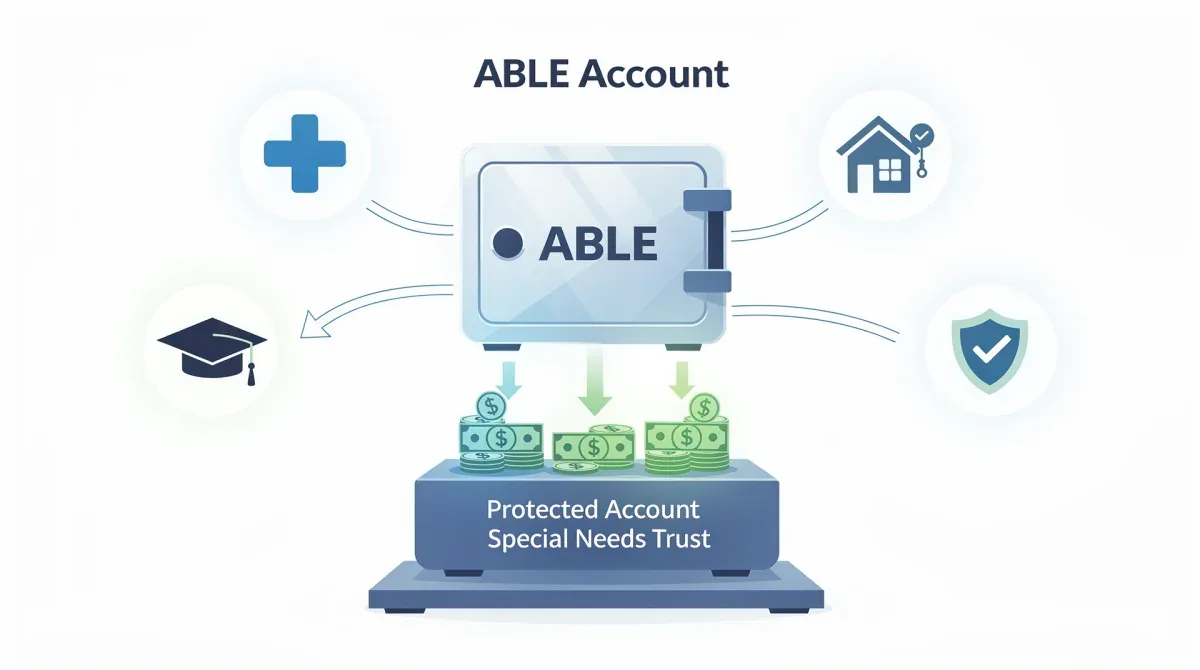
The first $100,000 held in a qualifying ABLE account is generally excluded when the Social Security Administration calculates an individual's countable SSI resources.
Balances exceeding this threshold may become countable and potentially cause SSI cash payments to be suspended when combined resources exceed the applicable limit.
Medicaid coverage may continue when SSI suspension results solely from excess ABLE funds, provided the beneficiary satisfies the other applicable requirements.
Qualified disability expenses
ABLE funds may be used for qualified disability expenses involving housing, education, transportation, employment support, healthcare, assistive technology, and other eligible purposes.
Qualified withdrawals generally receive favorable federal tax treatment, although nonqualified distributions may create additional tax obligations and affect public benefit eligibility.
Managing SSI asset caps through an ABLE account requires monitoring contributions, withdrawals, account balances, and documentation associated with disability-related expenditures.
Special considerations for housing withdrawals
ABLE account distributions intended for housing expenses receive specific treatment under SSI rules, making the timing of these withdrawals particularly important.
Housing distributions retained beyond the month when they are received may become countable resources and potentially affect eligibility during the following month.
Beneficiaries should coordinate housing withdrawals with actual payment dates and confirm applicable rules before retaining distributed funds for extended periods.
Spending down assets to meet SSI resource limits
Individuals with excess countable resources may reduce their available balances by paying legitimate expenses or purchasing property that qualifies for applicable resource exclusions.
This process is commonly described as spending down resources and should involve genuine transactions that provide appropriate value rather than artificial asset transfers.
Properly documented expenditures may help individuals comply with SSI asset caps, although spending money does not automatically resolve every existing eligibility problem.
Permissible spending options
Potential expenditures include necessary primary residence repairs, eligible transportation vehicle purchases, medical expenses, household furnishings, and other legitimate goods or services.
Paying existing debts at their actual value may also reduce available countable resources without involving an uncompensated transfer to another individual.
Before completing significant purchases, verify how the acquired property or financial transaction will be evaluated under the applicable SSI resource regulations.
Purchasing an eligible transportation vehicle
One vehicle used for transportation by an SSI beneficiary or a member of their household is generally excluded regardless of its market value.
Purchasing an eligible vehicle may therefore reduce available countable cash while providing transportation needed for medical appointments, employment, or other ordinary activities.
Additional vehicles may receive different treatment, so beneficiaries should confirm applicable exclusions before purchasing another automobile using available financial resources.
Paying for medical care and existing debts
Legitimate payments for medical treatment, adaptive equipment, prescription medications, and outstanding financial obligations may reduce the amount of cash available for personal support.
Keep invoices, receipts, payment confirmations, and relevant contractual documentation showing that these transactions involved actual expenses and appropriate compensation for the amounts paid.
Maintaining accurate documentation helps demonstrate compliance with SSI asset caps when the Social Security Administration reviews significant financial changes.
Gifting assets and transfer penalties
Giving money or property away to reduce countable resources may create serious eligibility consequences when assets are transferred for less than their fair market value.
Federal rules allow the Social Security Administration to impose periods of SSI ineligibility following certain uncompensated transfers made before or during benefit receipt.
Understanding these restrictions is essential when reviewing financial decisions that could affect SSI and other disability benefit eligibility requirements.
Understanding the 36-month transfer rules
SSI transfer provisions generally examine relevant uncompensated transactions occurring within thirty-six months before an application or during an individual's period of benefit receipt.
Disqualifying transfers can result in an SSI ineligibility period lasting up to thirty-six months, depending on the circumstances and value of the transferred resources.
These rules differ from certain Medicaid transfer provisions, meaning beneficiaries should not assume that one public assistance program's requirements automatically apply to another.
How transfer penalties are calculated
Transfer penalties generally consider the uncompensated value of the resources and the applicable monthly federal benefit rate, including qualifying federally administered state supplements.
The Social Security Administration determines the appropriate penalty period under applicable regulations, including relevant exceptions and any circumstances affecting the original transfer.
Individuals should obtain professional assistance before attempting to calculate how a particular transaction might affect their eligibility under SSI asset caps.
Understanding exceptions to transfer penalties
Some transfers may qualify for statutory exceptions, including certain transactions involving spouses, eligible individuals with disabilities, or appropriately established qualifying financial arrangements.
Exceptions may also apply under specific circumstances when an individual demonstrates that the transfer was made exclusively for reasons unrelated to establishing SSI eligibility.
Because these provisions involve detailed requirements, beneficiaries should seek individualized guidance rather than assuming that every gift or family transfer is permissible.
Reporting changes and maintaining compliance
SSI beneficiaries must provide accurate information about financial resources, income, living arrangements, and other circumstances that may influence their eligibility or monthly payments.
Failure to report relevant changes can result in incorrect payments, repayment obligations, financial penalties, or other consequences depending on the circumstances involved.
Regular financial reviews and timely communication help beneficiaries manage SSI asset caps without relying on incomplete information or outdated eligibility assumptions.
What changes should beneficiaries report?
Relevant changes include employment income, bank balances, acquired resources, asset sales, transfers of property, marital status, household arrangements, and other applicable financial developments.
Receiving an inheritance, financial gift, insurance payment, or legal settlement may also require reporting and assessment under the appropriate income and resource regulations.
Contact the Social Security Administration whenever uncertainty exists about whether a particular financial transaction or change in circumstances could affect your benefits.
When must changes be reported?
Beneficiaries should report changes as soon as possible and no later than ten days after the end of the month when they occurred.
For example, a relevant change occurring during November should generally be communicated to the Social Security Administration no later than December 10.
Maintaining copies of submitted documents and reporting confirmations can help establish that information was provided within the appropriate reporting period.
What happens when countable resources exceed the limit?
Excess countable resources may temporarily prevent SSI eligibility, depending on when the resources are evaluated and whether applicable exclusions or special provisions exist.
Returning below the applicable threshold may allow eligibility to resume when the individual continues satisfying other requirements established by the Social Security Administration.
Beneficiaries should report excess resources promptly rather than assuming that spending or transferring the money automatically resolves previous periods of ineligibility.
Conditional payments while selling excess property
Under certain conditions, individuals with excess countable property may receive conditional SSI payments while attempting to sell the property through an approved arrangement.
These arrangements may allow up to nine months for qualifying real property and up to three months for qualifying personal property.
Recipients may be required to repay conditional benefits from sale proceeds, making this a limited exception rather than a permanent increase in SSI asset caps.
Handling potential SSI overpayments
An overpayment may occur when someone receives SSI payments exceeding the amount they were eligible to receive under the applicable program requirements.
The Social Security Administration generally provides information concerning the overpayment, available appeal procedures, repayment requirements, and potential opportunities to request a waiver.
Review official notices carefully and respond within the stated deadlines rather than ignoring correspondence or assuming the financial obligation will disappear automatically.
Seeking professional guidance for asset management
Managing financial resources while receiving SSI may require specialized knowledge, particularly when beneficiaries encounter substantial inheritances, legal settlements, or complicated property ownership arrangements.
Attorneys experienced in disability benefits, elder law, and special needs planning can help individuals understand the legal consequences of different financial decisions.
Qualified financial professionals may also provide assistance with budgeting, documentation, and financial management strategies consistent with the requirements governing SSI asset caps.
When to consult a qualified professional
Professional assistance may be particularly valuable before establishing a trust, receiving a substantial inheritance, selling property, or completing a significant financial transfer.
Individuals experiencing temporary financial difficulties can also explore other assistance opportunities, including available unemployment benefits when they satisfy the relevant eligibility requirements.
Obtaining individualized guidance helps beneficiaries evaluate how different financial arrangements may interact with SSI, Medicaid, and other programs supporting their personal circumstances.
Summary of strategies for managing SSI asset caps
Managing SSI resources involves understanding applicable exclusions, maintaining accurate financial records, reporting relevant changes, and evaluating specialized savings arrangements when appropriate.
Beneficiaries should distinguish legal resource exclusions from uncompensated transfers that may trigger penalties or create additional complications involving their public assistance eligibility.
The following table summarizes important requirements and potential strategies for maintaining compliance with SSI asset caps during the 2026 calendar year.
Key Strategy | Brief Description |
|---|---|
Individual Resource Limit | $2,000 in countable resources. |
Couple Resource Limit | $3,000 in countable resources. |
Utilize Exemptions | Identify excluded resources such as a qualifying primary residence, transportation vehicle, and ordinary household belongings. |
Establish Qualifying Trusts | Consider properly structured special needs trusts with professional legal guidance. |
Open an ABLE Account | Save for qualified disability expenses through an eligible account. |
ABLE Eligibility in 2026 | Qualifying disability or blindness must have begun before age 46. |
ABLE Resource Exclusion | The first $100,000 generally does not count toward SSI resources. |
Strategic Spend-Down | Pay legitimate expenses or purchase qualifying excluded property while maintaining appropriate documentation. |
Transfer Penalties | Uncompensated transfers may result in SSI ineligibility for up to 36 months. |
Reporting Deadline | Report relevant changes promptly and no later than 10 days after the end of the month when they occurred. |
Professional Guidance | Consult qualified professionals before completing significant transactions involving trusts, inheritances, or property transfers. |
Frequently Asked Questions About SSI Asset Caps
What is the current SSI asset limit for individuals?
In 2026, the federal countable resource limit remains $2,000 for individuals and $3,000 for couples. Certain qualifying possessions and financial resources are excluded from these limits.
Can I own more than $2,000 and still receive SSI?
Yes. Your total assets may exceed $2,000 when some qualify for resource exclusions. Your countable resources must generally remain within the applicable eligibility limit.
Do gifts affect SSI eligibility?
Yes. Receiving gifts may affect income or resource calculations, while giving assets away for less than their fair market value may trigger transfer penalties.
Are ABLE accounts useful for SSI beneficiaries?
Qualifying ABLE accounts allow eligible individuals to save for disability-related expenses. The first $100,000 is generally excluded from SSI resource calculations.
What changed regarding ABLE account eligibility in 2026?
Beginning January 1, 2026, eligible individuals may qualify when their disability or blindness began before age 46, rather than before age 26.
What happens if my ABLE account exceeds $100,000?
The excess may count toward SSI resource limits and potentially cause cash payments to be suspended. Medicaid eligibility may continue under specified circumstances.
Can SSI beneficiaries own a house?
Yes. The home where a beneficiary lives generally qualifies for an exclusion, regardless of its market value. Additional properties may receive different treatment.
Can SSI beneficiaries own a car?
Yes. One vehicle used for transportation by the beneficiary or a household member is generally excluded from SSI resource calculations.
Can a special needs trust protect SSI eligibility?
A qualifying special needs trust may receive favorable resource treatment. However, the trust must satisfy applicable legal requirements, and distributions may still affect benefits.
Can I establish my own first-party special needs trust?
Federal law permits qualifying individuals to establish their own first-party special needs trusts, subject to applicable disability, age, repayment, and other legal requirements.
What happens if my resources temporarily exceed SSI asset caps?
You may become ineligible for SSI payments for affected months. Report the change promptly and ask the Social Security Administration about available options.
Can I pay off debts to reduce countable resources?
Paying legitimate debts at their actual value may reduce countable cash. Maintain appropriate documentation and verify the implications of significant financial transactions.
What happens if I receive an inheritance while receiving SSI?
An inheritance may affect income and resource calculations. Report it promptly and obtain qualified advice before transferring or distributing inherited assets.
Does transferring money to a relative protect SSI eligibility?
Not necessarily. Uncompensated transfers may result in periods of ineligibility lasting up to 36 months unless an applicable exception exists.
When must I report changes in my financial resources?
Changes should be reported as soon as possible and generally no later than ten days after the end of the month when they occurred.
Are SSI resource limits the same as SSDI requirements?
No. Social Security Disability Insurance generally does not impose the same resource limits as Supplemental Security Income. The programs have different eligibility requirements.
Should I get professional help managing SSI asset caps?
Professional guidance can be particularly valuable when dealing with trusts, inheritances, settlements, substantial financial transfers, or uncertainty about applicable resource exclusions.
Conclusion: Maintaining SSI eligibility through responsible asset management
Understanding SSI asset caps helps beneficiaries make informed financial decisions, identify available resource exclusions, and protect access to essential Supplemental Security Income payments.
Qualifying ABLE accounts, special needs trusts, legitimate expenditures, and other financial assistance programs may provide additional support when their respective eligibility requirements are satisfied.
By maintaining accurate records, reporting financial changes promptly, and obtaining professional guidance when necessary, beneficiaries can manage their resources responsibly while complying with federal regulations.