Claiming Full Child Tax Credit 2026: Income Thresholds Explained
Advertisements
The Child Tax Credit 2026 offers qualifying American families up to $2,200 per eligible child, making income limits essential for accurate tax planning.
Understanding filing status, modified adjusted gross income, and dependent requirements can help parents estimate their potential federal tax benefits.
This guide explains eligibility, income thresholds, refundable amounts, documentation, and practical steps for preparing a 2026 federal tax return.
Understanding the Child Tax Credit in 2026
The Child Tax Credit 2026 provides eligible taxpayers with a federal tax benefit designed to help offset some costs associated with raising children.
Under the applicable tax rules, the maximum credit reaches $2,200 per qualifying child, subject to income limitations and other eligibility requirements.
Families can use this information for financial planning, although their actual benefit depends on individual tax circumstances and federal calculations.
What Changed for the 2026 Tax Year?
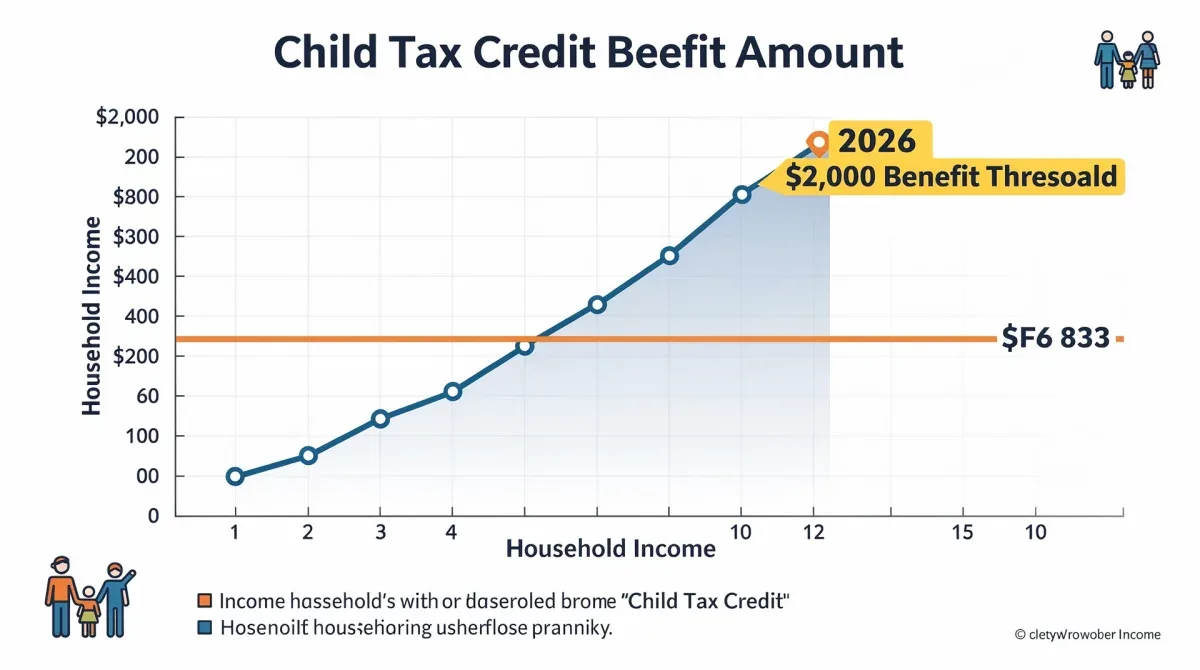
The maximum Child Tax Credit increased from $2,000 to $2,200 following federal tax legislation enacted in 2025.
For tax year 2026, the IRS also identifies a maximum refundable amount of $1,700 per eligible child through the Additional Child Tax Credit.
These rules apply to income earned during 2026, with federal tax returns generally submitted during the 2027 filing season.
Key Income Thresholds for the $2,200 Benefit
Income thresholds determine when the maximum Child Tax Credit 2026 begins decreasing for taxpayers with higher earnings.
Married couples filing jointly generally face a $400,000 modified adjusted gross income threshold before the credit begins to phase out.
For other filing statuses, including single taxpayers and heads of household, the corresponding threshold is generally $200,000.
Single Filers and Head of Household Thresholds
Single taxpayers and individuals filing as head of household generally encounter the same $200,000 income threshold for this credit.
When modified adjusted gross income exceeds that level, the credit begins decreasing according to the federal phase-out calculation.
The Child Tax Credit 2026 may remain partially available above the threshold, depending on income and the number of qualifying children.
Married Filing Jointly Income Limits
Married couples filing jointly generally qualify for the maximum credit calculation when their modified adjusted gross income does not exceed $400,000.
The IRS uses adjusted gross income as a starting point, with applicable modifications determined under the tax credit rules.
Both spouses' financial information must be considered when preparing a joint return and determining the available Child Tax Credit 2026.
How the Child Tax Credit Phase-Out Works
The Child Tax Credit 2026 does not necessarily disappear immediately when income exceeds the applicable threshold.
Instead, federal rules generally reduce the combined available credit by $50 for each $1,000, or fraction thereof, above the threshold.
The final reduction depends on modified adjusted gross income, filing status, qualifying dependents, and the amount of credit initially available.
Example of an Income-Based Credit Reduction
Consider a married couple filing jointly with one qualifying child and modified adjusted gross income of $405,000.
Their income exceeds the $400,000 threshold by $5,000, resulting in a potential $250 reduction under the phase-out calculation.
Assuming other eligibility requirements are satisfied, their calculated $2,200 credit would decrease to $1,950 before other applicable limitations.
Eligibility Requirements Beyond Income
Income is only one factor determining whether a family qualifies for the Child Tax Credit 2026.
The child must satisfy federal age, relationship, residency, support, dependency, citizenship or residency-status, and identification requirements.
Taxpayers should review each requirement carefully because meeting the income threshold alone does not guarantee the maximum benefit.
Qualifying Child Definition for 2026
A qualifying child must generally be younger than 17 at the end of the relevant tax year.
The relationship requirement includes children, stepchildren, eligible foster children, qualifying siblings, and certain descendants of those relatives.
The child must also satisfy applicable residency and support tests and be properly identified as a dependent.
Social Security Number Requirements in 2026
The Child Tax Credit 2026 includes important Social Security number requirements affecting both qualifying children and taxpayers claiming the benefit.
A qualifying child generally needs a valid Social Security number meeting the employment-related requirements established by federal law.
Taxpayers must also meet applicable identification rules, with specific provisions addressing married couples filing joint federal returns.
Identification Rules for Married Couples
For a married couple filing jointly, at least one spouse generally must have a valid Social Security number for employment.
The other spouse must satisfy applicable taxpayer identification requirements, which may allow a qualifying Individual Taxpayer Identification Number.
Families should consult current IRS instructions to verify identification deadlines and requirements before claiming the Child Tax Credit 2026.
Understanding the Refundable Child Tax Credit
The Child Tax Credit 2026 includes a potentially refundable component called the Additional Child Tax Credit, commonly abbreviated ACTC.
For 2026, the maximum refundable portion is $1,700 per qualifying child, subject to income and eligibility calculations.
Not every eligible family automatically receives that amount because refundable benefits depend on specific federal tax rules.
What Is the Additional Child Tax Credit?
The Additional Child Tax Credit may provide a refund when eligible taxpayers cannot use their entire allowable credit against federal income tax liability.
Earned income requirements and other limitations influence the amount that can be claimed through this refundable component.
According to IRS guidance, taxpayers generally need at least $2,500 in earned income to qualify for the ACTC.
How Earned Income Affects Refundable Benefits
Earned income plays an important role in calculating the refundable portion of the Child Tax Credit 2026.
Qualifying wages and certain self-employment earnings may contribute to the calculation, while other income categories receive different treatment.
The refundable amount is determined through federal formulas rather than simply multiplying the number of children by $1,700.
Why Some Families Receive Less Than Expected
Families with limited earned income may qualify for a smaller refundable credit even when their children meet eligibility requirements.
Other taxpayers may use some or all of their available credit to reduce federal income tax owed.
Completing the appropriate calculation helps distinguish the total Child Tax Credit 2026 from the portion potentially available as a refund.
Impact of Tax Law Changes on the 2026 Credit
Federal legislation enacted in 2025 increased the maximum Child Tax Credit and established updated requirements for eligible taxpayers.
The IRS subsequently published official 2026 inflation adjustments confirming the maximum $2,200 credit and $1,700 refundable portion.
Families should rely on applicable tax-year instructions because filing rules and available benefits can differ from previous years.
Why Tax Year and Filing Year Matter
Tax year 2026 refers to income and qualifying circumstances occurring between January and December 2026.
Most taxpayers will prepare and submit their corresponding federal income tax returns during the 2027 filing season.
Understanding this distinction helps prevent confusion when comparing Child Tax Credit 2026 requirements with earlier tax returns.
Strategies for Maximizing Your Child Tax Credit
Effective planning begins with confirming eligibility and maintaining accurate records of income, filing status, and qualifying children.
Taxpayers near the income thresholds may benefit from reviewing deductions and eligible contributions that affect modified adjusted gross income.
However, financial decisions should reflect broader household needs rather than focusing exclusively on maximizing one federal tax credit.
Income Management Techniques
Certain retirement contributions and other qualifying adjustments can influence adjusted gross income when permitted by applicable federal rules.
Eligible contributions to traditional retirement accounts or Health Savings Accounts may offer tax advantages depending on individual circumstances.
Discussing these options with a qualified financial advisor can support informed decisions about Child Tax Credit 2026 planning.
Record Keeping and Documentation
Accurate documentation helps families prepare federal tax returns and respond to questions concerning the Child Tax Credit 2026.
Important records may include identification information, income statements, dependent details, and documentation supporting residency or relationship requirements.
Organized financial documents also make it easier to identify mistakes before submitting a return or responding to IRS correspondence.
Documents Families Should Prepare
Taxpayers should collect applicable wage statements, self-employment records, and other income documents needed to complete their returns.
They should also confirm qualifying children's Social Security numbers, dates of birth, and information required to establish dependency.
Keeping relevant records available can simplify Child Tax Credit 2026 calculations and reduce delays caused by incomplete information.
How to Claim the Child Tax Credit in 2026
Eligible taxpayers generally claim the Child Tax Credit through their federal income tax return using the appropriate IRS forms.
Form 1040 identifies eligible dependents, while Schedule 8812 calculates the Child Tax Credit and Additional Child Tax Credit.
Correctly completing these forms is essential for determining the available benefit and avoiding preventable filing errors.
Understanding Schedule 8812
Schedule 8812 is the IRS form used to calculate credits for qualifying children and certain other dependents.
It accounts for applicable income thresholds, potential credit reductions, and refundable benefit calculations under the relevant tax rules.
Families can review the form's official instructions when preparing their Child Tax Credit 2026 claim or working with tax software.
Common Mistakes Families Should Avoid
One frequent mistake involves assuming that every child listed as a dependent automatically qualifies for the full credit.
Another involves confusing adjusted gross income with modified adjusted gross income or overlooking the requirements for valid Social Security numbers.
Careful review of eligibility information can help prevent inaccurate Child Tax Credit 2026 claims and unnecessary processing complications.
Errors That May Delay Tax Processing
Incorrect identification numbers, mismatched dependent information, and incomplete forms can create complications when federal tax returns are processed.
Families should also avoid claiming the same qualifying child on competing returns when federal dependency rules do not permit it.
Checking all information before submission can reduce errors, although processing times ultimately depend on individual circumstances and IRS procedures.
Child Tax Credit Versus Other Family Benefits
The Child Tax Credit 2026 is separate from other federal tax benefits designed to assist eligible households.
Depending on their circumstances, families may qualify for the Earned Income Tax Credit or certain dependent care benefits.
Each program has different requirements, so qualifying for one credit does not automatically establish eligibility for another.
Understanding Additional Financial Support
Families experiencing employment changes may also want to review information about available state unemployment assistance and related financial programs.
Resources discussing unemployment benefits can provide broader context, although those programs operate separately from the federal Child Tax Credit.
Evaluating different forms of assistance helps households understand their options without assuming all benefits follow identical eligibility rules.
How the Credit Affects Your Tax Refund
The Child Tax Credit 2026 can reduce federal income tax liability, while eligible refundable amounts may increase a taxpayer's refund.
The final refund also depends on income tax withholding, estimated payments, other credits, and the individual's overall tax calculation.
Therefore, receiving the maximum Child Tax Credit does not necessarily mean receiving an additional $2,200 cash refund per child.
Refundable and Nonrefundable Credits Explained
Nonrefundable credits generally reduce eligible federal income tax liability without independently creating a refund beyond that liability.
Refundable credits may produce a refund when their applicable requirements are satisfied, even if little federal income tax remains owed.
Families should distinguish these mechanisms when estimating the financial impact of the Child Tax Credit 2026.
Planning for the 2027 Tax Filing Season
Families can prepare for the next filing season by reviewing income estimates and confirming which children meet the 2026 requirements.
Maintaining accurate records throughout the year can reduce the effort required when tax documents become available.
Taxpayers should also monitor official IRS announcements for final forms, filing dates, and any applicable procedural updates.
When to Review Your Tax Information
A practical starting point is reviewing household income and dependent information before the end of the 2026 calendar year.
After receiving annual income statements, taxpayers can compare their records and calculate eligibility using current tax-year instructions.
Anyone with complicated circumstances may benefit from qualified tax preparation assistance before submitting the Child Tax Credit 2026 claim.
Official IRS Resources for the Child Tax Credit

The Internal Revenue Service provides official guidance explaining Child Tax Credit eligibility, maximum amounts, and income limitations.
Families can consult the IRS Child Tax Credit information page to review current rules and related resources.
Government instructions are particularly important when preparing returns because tax requirements can differ from simplified summaries found elsewhere online.
Why Official Guidance Matters
IRS resources distinguish the maximum available credit from actual eligibility based on income, identification, and dependency requirements.
They also provide information about Schedule 8812, refundable credit calculations, and procedures for correcting certain tax filing problems.
Using these materials helps families evaluate Child Tax Credit 2026 information without relying on outdated or unsupported benefit claims.
Key Point | 2026 Rule |
|---|---|
Maximum Child Tax Credit | Up to $2,200 per qualifying child. |
Maximum Refundable Portion | Up to $1,700 per qualifying child, subject to eligibility. |
Married Filing Jointly | Phase-out generally begins above $400,000 in modified adjusted gross income. |
Other Filing Statuses | Phase-out generally begins above $200,000 in modified adjusted gross income. |
Qualifying Child Age | Generally younger than 17 at the end of 2026. |
Required Tax Form | Form 1040 with Schedule 8812, when applicable. |
Frequently Asked Questions About Child Tax Credit 2026
How much is the Child Tax Credit in 2026?
The maximum Child Tax Credit for tax year 2026 is $2,200 per qualifying child. The actual amount depends on income, qualifying dependents, identification requirements, and federal income tax calculations.
What are the main income thresholds for the Child Tax Credit?
The phase-out generally begins when modified adjusted gross income exceeds $200,000 for single taxpayers, heads of household, and most other filing statuses. Married couples filing jointly have a $400,000 threshold.
How does the Child Tax Credit phase-out work?
The combined credit generally decreases by $50 for every $1,000, or fraction thereof, by which modified adjusted gross income exceeds the applicable threshold. The remaining credit depends on the taxpayer's circumstances.
Can families receive a refundable Child Tax Credit?
Yes. Eligible families may qualify for the Additional Child Tax Credit, which provides a potentially refundable amount of up to $1,700 per qualifying child for 2026. Earned income and other federal requirements apply.
What age must a child be to qualify?
A qualifying child generally must be younger than 17 at the end of the tax year. Other requirements involving dependency, relationship, residency, support, identification, and citizenship or residency status must also be satisfied.
Do parents need Social Security numbers?
Yes. Federal rules establish Social Security number requirements for qualifying children and taxpayers claiming the credit. Special provisions apply to married couples filing jointly, including identification requirements for the other spouse.
Can married couples filing jointly claim the full credit?
Married couples filing jointly may qualify for the maximum Child Tax Credit when their modified adjusted gross income does not exceed $400,000 and all other eligibility requirements are met.
Which forms are needed to claim the Child Tax Credit?
Taxpayers generally identify qualifying dependents on Form 1040 and use Schedule 8812 to calculate the available Child Tax Credit, Additional Child Tax Credit, and certain other dependent credits.
Can contributions to retirement accounts affect eligibility?
Certain qualifying contributions may reduce adjusted gross income depending on the account type and applicable tax rules. However, not every contribution produces the same tax treatment, and individual circumstances should be reviewed.
Is the Child Tax Credit the same as the Child and Dependent Care Credit?
No. These are separate federal tax benefits with different purposes and eligibility conditions. The benefit planning process should distinguish tax credits from employment benefits and other household assistance programs.
When will families claim the 2026 Child Tax Credit?
Most qualifying taxpayers will claim the credit on federal income tax returns covering the 2026 tax year, generally filed during the 2027 tax filing season.
What This Means for American Families
The Child Tax Credit 2026 offers qualifying families up to $2,200 per child, with income thresholds determining when reductions begin.
Understanding eligibility, refundable benefits, required identification, and accurate documentation can help taxpayers prepare more reliable federal tax returns.
Families should review official IRS instructions and consider professional assistance when necessary to determine the credit available for their circumstances.